Make your hardware buildable
Try Buildable
Examples

Real results, not a mockup.

Seven real sample parts, one dedicated to each manufacturing process plus a multi-part assembly, each designed around genuine findings from Buildable's own detectors and checked live through the actual per-process engines. No fabricated numbers, no invented customer story. As real usage grows, this gallery will grow with genuine, permissioned examples from actual parts.

Interactive example Assembly interference

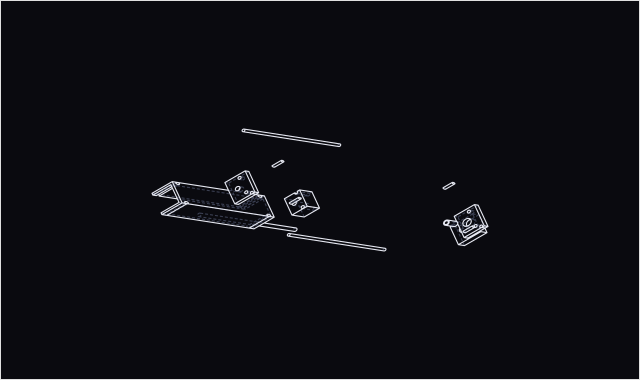
A 13-part compact linear actuator: housing, end plates, lead screw, motor mount, coupler, carriage, guide rails, fasteners. The motor coupler was drawn without accounting for how far the motor mount's registration boss reaches back.
Parts13 real solids, split from one STEP compound
Interference found1 pair, 550.1 mm³ overlap
BasisTrue boolean intersection via the CAD kernel
ConfidenceMeasured directly
Why it matters: the motor mount and the coupler sleeve can't both exist as designed. In a real build, the coupler physically can't seat where it's drawn.
Open this example →
Interactive example FDM: a real recheck, not a rubber stamp

A wall-mount sensor bracket: a cantilevered shelf overhangs the mounting plate, and a support rib was drawn too thin. Reorienting the part is the standard first move, and Buildable shows honestly how much it actually helps, not a rubber-stamped "fixed."

FindingsOverhang, thin wall (0.6mm), bridge (64.4mm span)
Overhang area, before → after reorient5,107.9 mm² → 1,152.6 mm² (77% less)
What reorient didn't fixThin wall unaffected; bridge span still 46.9mm
ConfidenceMeasured directly
Why it matters: auto-orient genuinely helps overhang, and Buildable says so honestly, without pretending it also solved the thin rib or the cantilever it didn't touch.
Open this example →
Interactive example Injection molding: the same shape, a different reality

A consumer-electronics-style housing shell, walls modeled with no draft at all: fine for a printer, a genuine problem the moment the process changes to a mold that has to release the part.

Draft736 flagged triangles, 0° walls
Wall uniformity240 hits, one reading 28mm vs a 2mm median
Undercuts10 hits, 8mm void height
BasisRay-cast draft measurement along the pull axis
Why it matters: without draft, a mold can't release the part without scraping or sticking. This is Buildable's process-aware intelligence on real geometry, not a generic checklist.
Open this example →
Interactive example CNC: real findings, none of them critical

A precision machined mounting plate with an unfilleted rectangular pocket: plenty of sharp internal corners no round end mill can reach, plus one pocket cut deeper than its width comfortably allows.

Checks applicable2 (tool access, deep pockets)
Tool access9 hits, unfilleted pocket corners
Deep pocket1 hit, 5.33:1 depth-to-width
StatusNeeds attention (0 critical)
Why it matters: a real end mill leaves its own radius behind at every internal corner. Ten features flagged, correctly none marked critical: a machinist would fillet them, not reject the part. Neither check has an automatic fix today, so Buildable explains and recommends rather than pretending to resolve it.
Open this example →
Interactive example Casting: a mold that can't release its own core

A structural gearbox-style housing modeled with vertical walls and a fully enclosed cavity: no draft anywhere, and no core-print access for the sand or die to actually reach the inside.

Draft180/350 triangles at 0°
Wall uniformity23 hits, worst 24mm vs an 11.16mm cap
Undercuts1,062 hits, sealed cavity, no core access
Draft fixPartial, verified: 180 → 172 on the outer walls
Why it matters: Buildable's real draft fix genuinely works on the 4 flat outer walls, verified before and after, and is honest that the cored cavity and cylindrical boss still need a human's tapered-core redesign, not silently claimed as solved.
Open this example →
Interactive example SLA: trapped resin, for real this time

A hollow electronics enclosure with a genuinely sealed interior cavity: uncured resin has nowhere to drain during printing, and a wide flat span bridges across the open bottom.

Trapped volume1 hit, fully sealed cavity
BridgingCritical, 63.5mm unsupported span
OverhangWarning, mostly an unavoidable flat base
Thin wall / stabilityClean
Why it matters: no automatic drain-hole fix exists yet, so Buildable explains the real cavity it found and recommends adding a vent, rather than claiming to fix what it can't.
Open this example →
Interactive example Sheet metal: a bend drawn without minimum radius

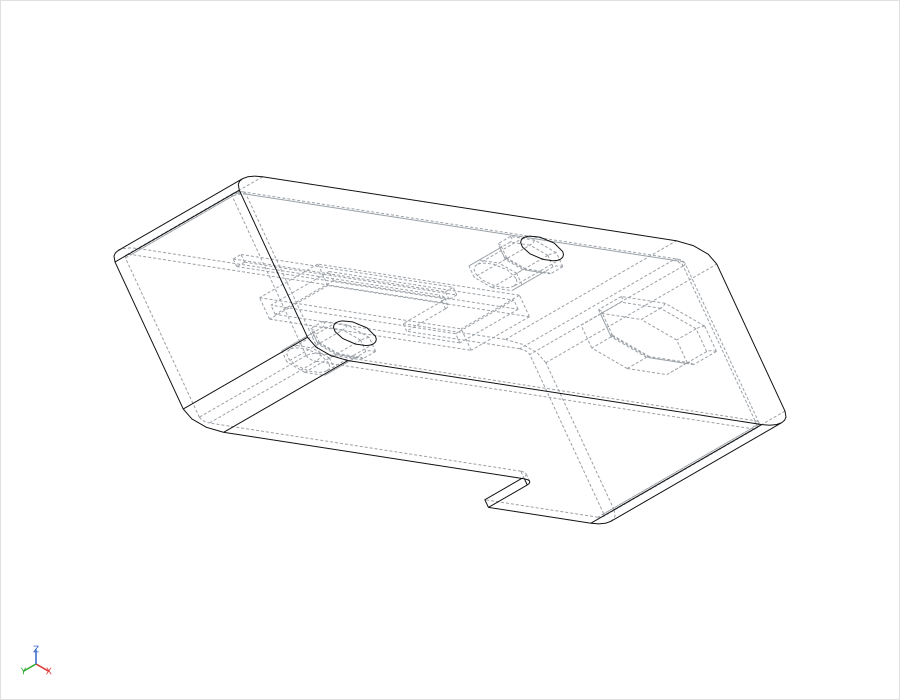
A folded bracket, two walls rising from adjacent edges of one base plate, the shared corner filleted at less than the material's own gauge and never relieved before the fold.

Bend radius1 hit, ~0.27mm inside radius on a 2mm gauge
Bend relief7 reads at the unrelieved corner and nearby edges
Flange length / holes near bendsClean (needs an open flat-pattern edge to evaluate)
StatusNeeds attention (0 critical)
Why it matters: a press brake needs a real minimum radius and a relief cut where two folds meet, or the material cracks or tears as it forms. No automatic fix exists for this yet, so Buildable explains and recommends.
Open this example →
Try it yourself: every card above opens its own real sample, in the actual app, no file needed. No file needed